Brands didn't need another AI tool. They needed a team.
PhotoG gives a full marketing team, research, strategy, creative, and ops, to businesses that could never staff one. These four AI agents don't just advise; they run the whole campaign and publish it, with a person signing off at every step. On a four-person design team with no PM, I owned the flow the product runs on.

The tools were fine. The hand-offs between them weren't.
Marketing wastes 30 to 40% of a $700B spend, not on bad ideas, on fragmentation. Every hand-off, research to strategy to content to execution, drops context, and the team turns into a human data-transfer system.

Insights stay trapped in silos, exported by hand.

By the time strategy is set, the first insights are stale.
Insights never reach the creators; 60% of time goes to tool-switching.
Manual updates push response time to weeks, not minutes.
of team time is wasted switching between tools.
of ad budgets are wasted on poorly targeted, disconnected campaigns.
The client asked for a full marketing team, as AI.
So we gave brands a team, not another tool.
The ask came with a shape: four AI roles a brand already hires, a research analyst, brand strategist, creative director, and ops manager. My bet was on the form, mirror the team a brand already runs instead of teaching them a new AI workflow.

The client wanted a human agency. I argued for an efficient one.
With no PM, the product calls fell to design, and this was the biggest. The brief wanted four agents debating like a real team, but that proved hard to make reliable, and it pulled against what a B2B tool is for: efficiency and a focused, repeatable flow. My call: keep the team of specialists, but move work down one clear line, a person signing off at every hand-off.

All four roles share one workspace.
In a real agency, work degrades at the hand-offs, where context slips and someone rebuilds it by hand. So the insight report, strategy, content, and schedule live in one place, one brand voice, one report the whole team works from.

Nothing ships until a person signs off.
In B2B, a wrong call isn't a bad photo, it's spend and a brand's reputation. So a human checkpoint sits at every stage, each costing a little speed, and I kept every one. The AI carries the intelligence; the team keeps the final say.
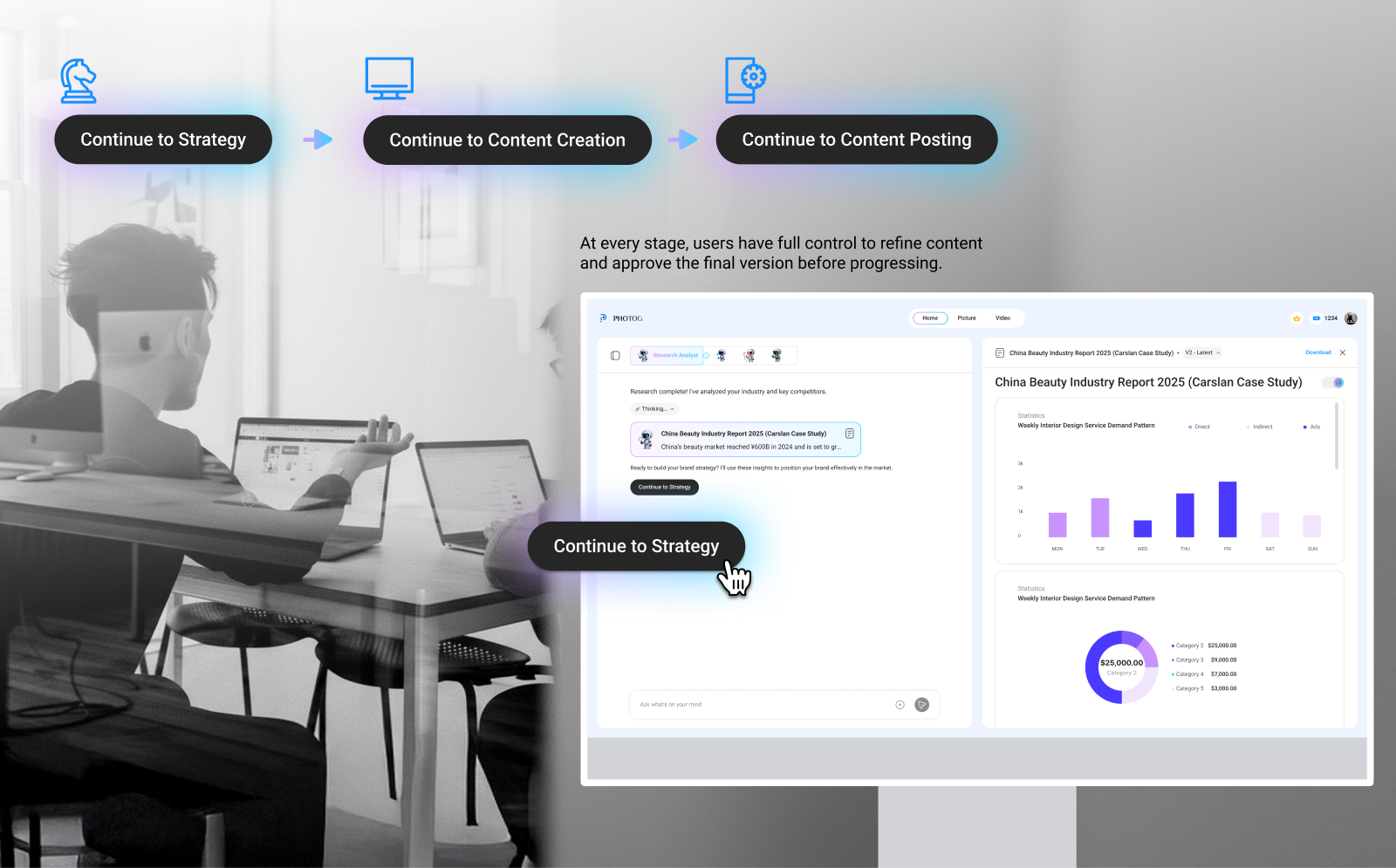
The pipeline is the navigation.
Four specialists, one shared workspace. Pick one and the whole thing re-tools for their job: a market report, an editable strategy, a post composer, a phone-ready preview.
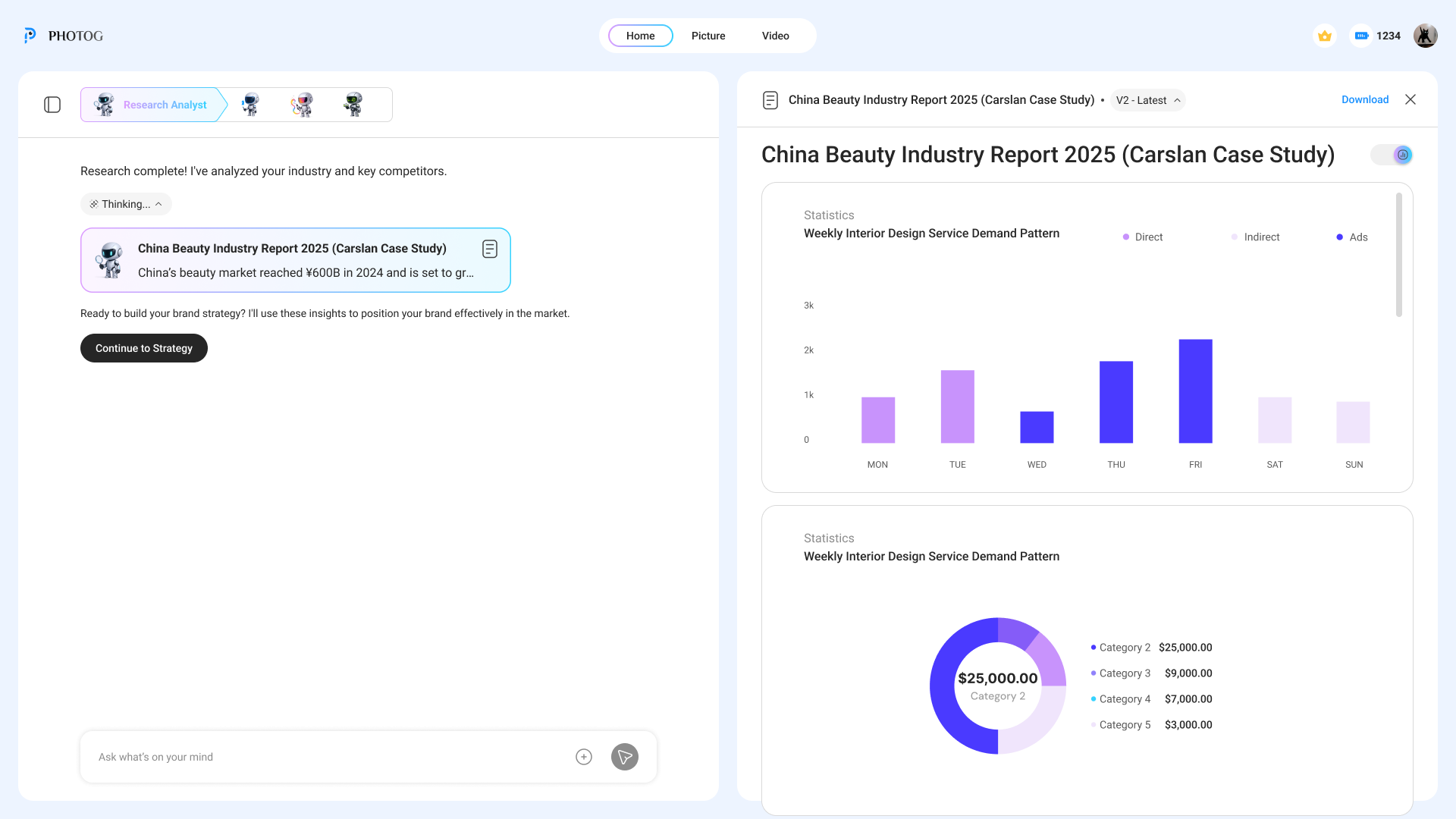
It shipped, and the numbers held.
Tight window, no PM. I worked end to end, research, architecture, UX, visuals, design system, eng handoff, to one rule: every decision had to survive a 60-second demo. Verified with the 1MORE partnership.
Built in weeks, scaled in months.
Three things I'd carry into the next agentic system.
The more an AI acts on its own, the less transparency alone buys you. Everyone shows the model's reasoning now, so trust moves to something harder: a clear place for a person to say no at every hand-off.
A multi-agent product lives or dies on one question: who is holding the work right now. Keep that legible and the pipeline itself becomes the navigation, not a black box you hope is doing its job.
Adoption follows a familiar shape long before it follows capability. Map the system onto a model people already run in their heads, and they trust the form before they trust any single feature.

The best AI products don't ask people to change. They show up already speaking the language you work in.

An AI-driven social-media creation OS. Planning, generation, and publishing, brought into one flow.
Want a closer look?
Happy to walk you through the agent UX, the workflow, and the system decisions behind PhotoG.