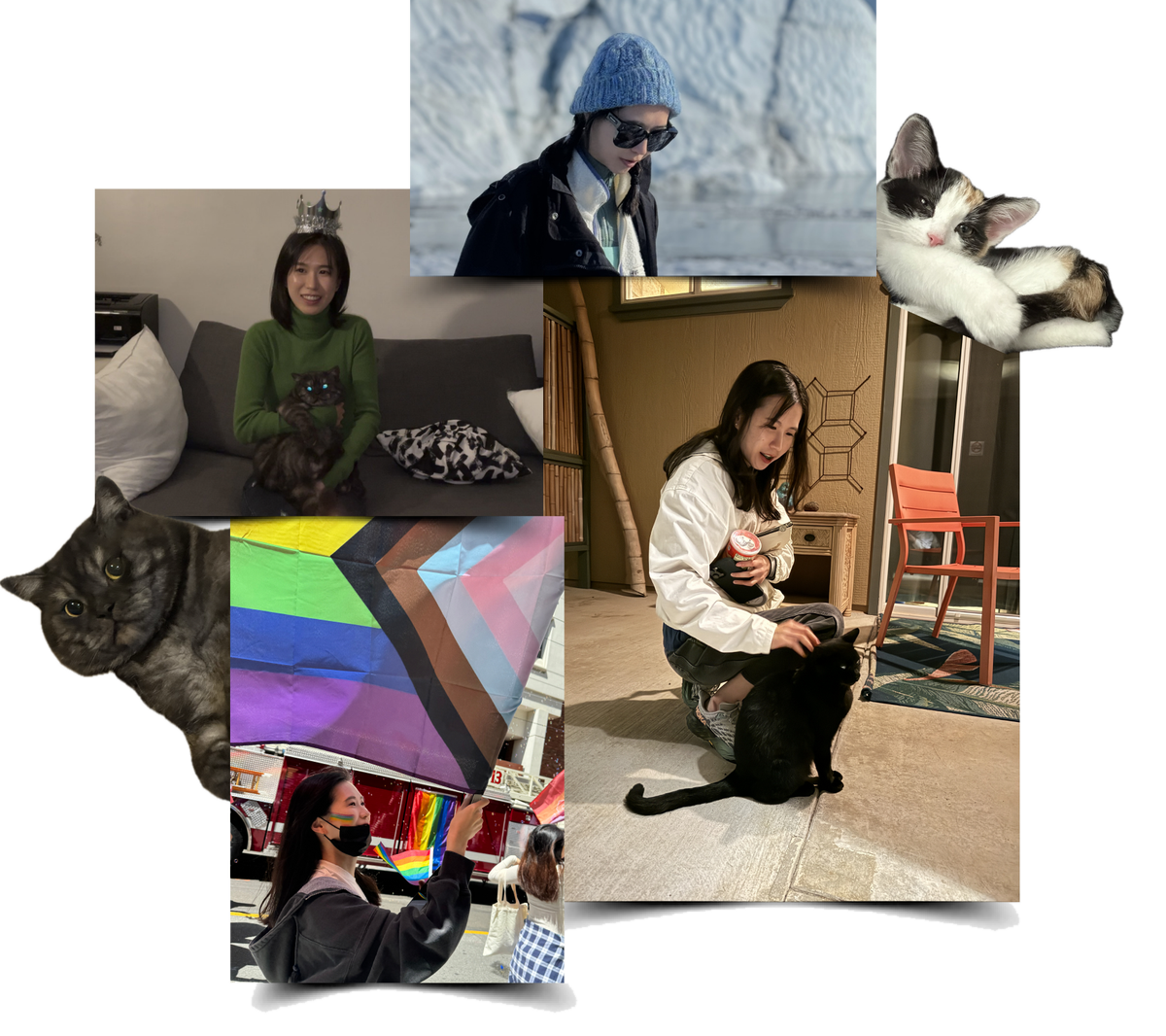
The human behind the pixels
Hello world!
I am Jingyi Zhu, a UX designer currently living in the Bay Area California. I enjoy employing my problem-solving mindset 🧠 and innovative perspective 🎨 to craft thoughtful solutions that benefit both users and business.
The majority of my projects are recognized for assisting purpose-driven organizations in developing user-friendly and practical platforms tailored to their communities. Social responsibility, scalability, and inclusiveness are fundamental to my approach. I firmly believe in the transformative potential of design and advocate for its use in creating significant and positive change.
Beside being a designer; I'm also a 'full-time' cat mom 😺, self-taught photographer 📷, and astrology enthusiast 🔮 currently. You can find me hiking in the fall/spring, skiing in the winter, and swimming in the summer.
My take on AI product design
The through-line in my work
People keep asking whether AI will replace designers. It's the wrong question. As models grow more autonomous, the bottleneck moves from capability to context, and the designer's role moves with it: from Human-in-the-Loop, approving each step, to Human-on-the-Loop, setting direction and stepping in where it matters. When anyone can generate a hundred screens in a minute, judgment becomes the scarce thing, and the layer I design is what makes that autonomy trustworthy.
My design process
So my process flexed to match. Research still comes first, but instead of describing an idea I now build a working version, test real behavior in days, keep what holds, and cut what doesn't. Non-linear, quick to test and correct.
What vibe coding changed
- Research the problem
- Wireframe, then mockups
- Write the spec
- Hand off to engineering
- Learn what's off after ship
- Research, same as ever
- Vibe-code a working version
- Test real behavior in days
- Keep what works, cut the rest
- Hand off a running prototype and a Figma spec
Same rigor, less guessing. AI does the grunt work, but for B2B I still book the demos and dig in myself, and I hand off a running branch, not just a file. The tools change every month. The judgment doesn't.
Let's work together.
I'd love to hear about new opportunities, anything design related. If you're building something ambitious and want someone to own the messy middle with you, let's talk.