
PhotoG is the world’s first agentic-AI marketing agency. Four AI agents, one workflow, designed around how marketing teams actually think. From a single product brief to a finished campaign.
The brands we talked to weren’t behind on AI. They had ChatGPT. They had Midjourney. They had Jasper, Copy.ai, and a dozen Notion templates for prompt libraries. And they still couldn’t get a campaign out the door.
Small marketing teams were stuck between disconnected tools and manual workflows. 6 to 8 separate tools for research, strategy, design, and publishing. Hours of manual data transfer between them. No centralized intelligence holding it together. For top-tier beauty brands running daily campaigns across China and Southeast Asia, this gap was the whole problem.



.svg)


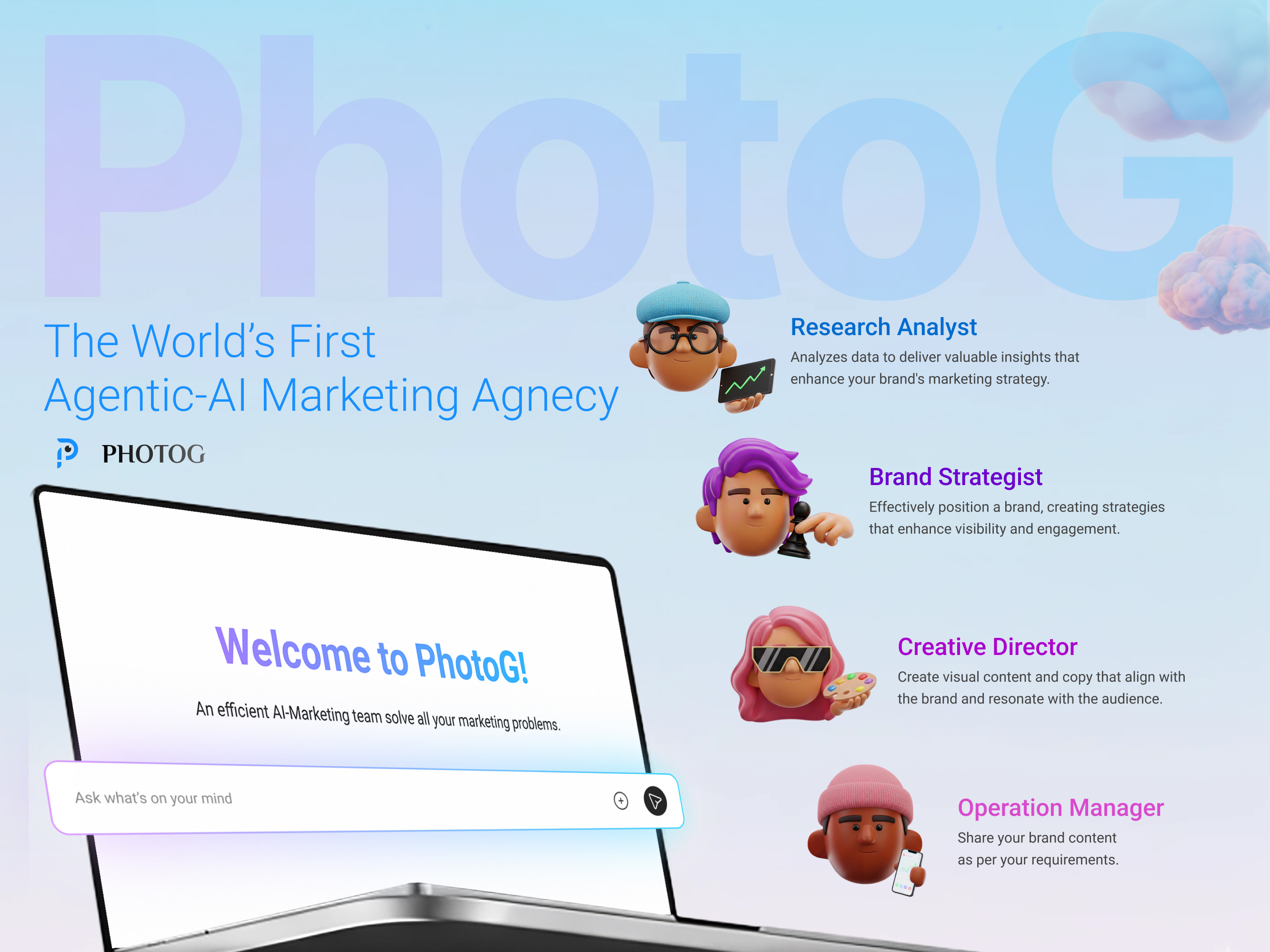
Marketing teams already know how to work. They have research analysts, brand strategists, creative directors, and operations managers. They’ve been collaborating this way for fifty years.
So instead of asking users to learn a new AI workflow, PhotoG learns theirs. Four specialized AI agents, each playing a role brands already hire for. The user briefs the team and the team takes it from there.
We call this the Digital Life Matrix. The world’s first agentic-AI marketing agency, built around the team structure marketing has used for decades.
A team only feels like a team if you can see them working. So we built a process monitor right into the experience.
When you submit a brief, the four agents don’t just disappear into a black box. You watch them line up. You see who’s on, who’s next, what they’re thinking about, and what they’ll hand off to whom.
Users stop wondering what the AI is doing. They can see it.


Real marketing teams don’t work in a queue. The strategist doesn’t sit idle while research finishes. The creative director starts thinking the moment the brief lands. Operations is already planning the rollout.
PhotoG works the same way. Once you submit a product brief, all four agents start in parallel. Each one delivers an output that fits its role: an industry report, a trend deck, a piece of post content, a publishing schedule.
The output isn’t one document. It’s a campaign, ready to ship.
Inside the workspace, projects stack like a real marketing team’s queue. The research analyst writes industry reports. The brand strategist drafts positioning. The creative director generates product images. Operations schedules the post. All in one place, all in the same brand voice.

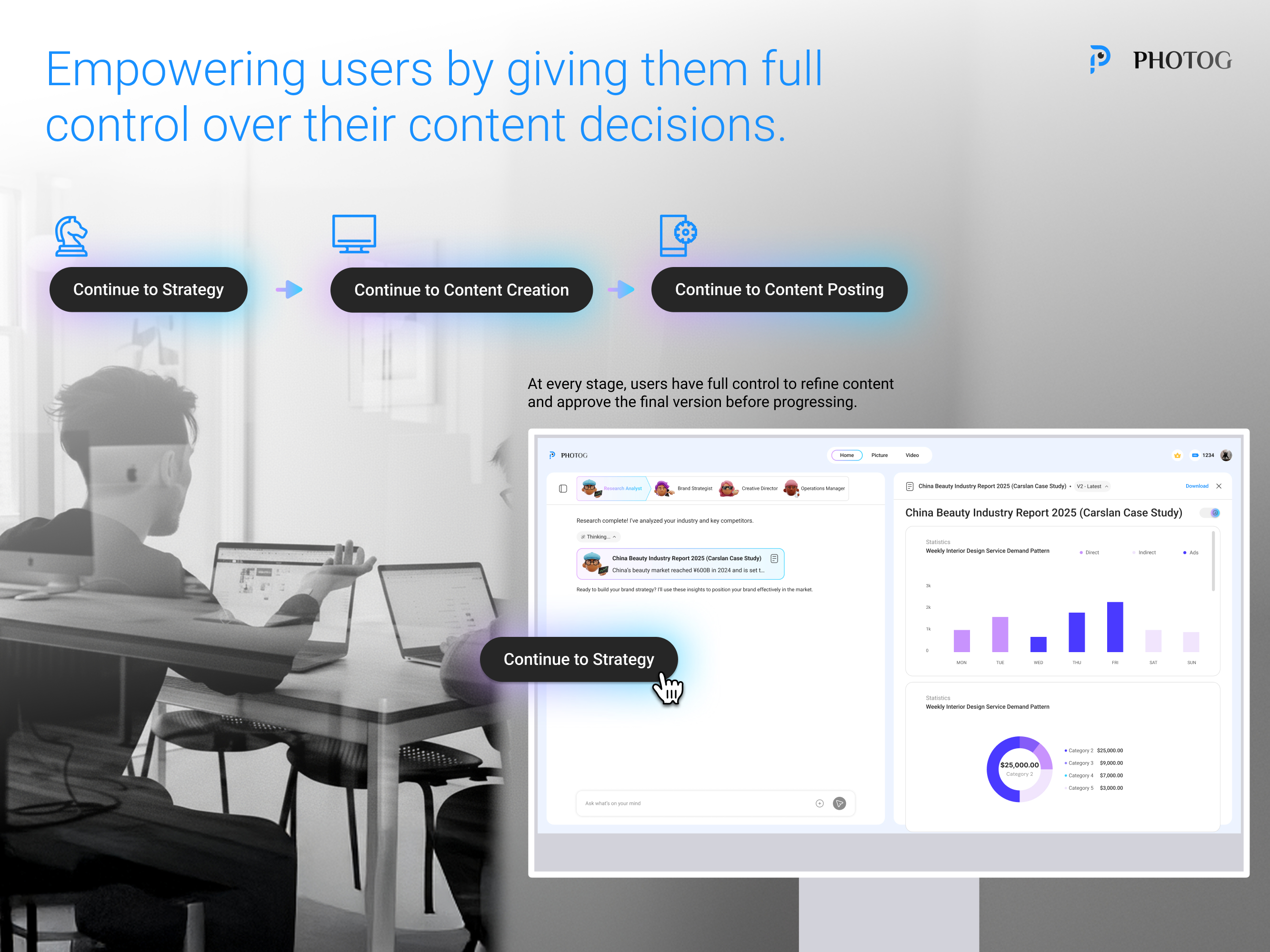
The most common fear about AI agents is that they’ll run away on their own. So we designed PhotoG around the opposite principle. Every stage hands back to the user.
“Continue to Strategy.” “Continue to Content Creation.” “Continue to Content Posting.” At each step, the user reviews the work, refines it, and only then approves it forward. The team works. The user decides.
This is the difference between a tool that pretends to be a teammate and a teammate you actually trust.
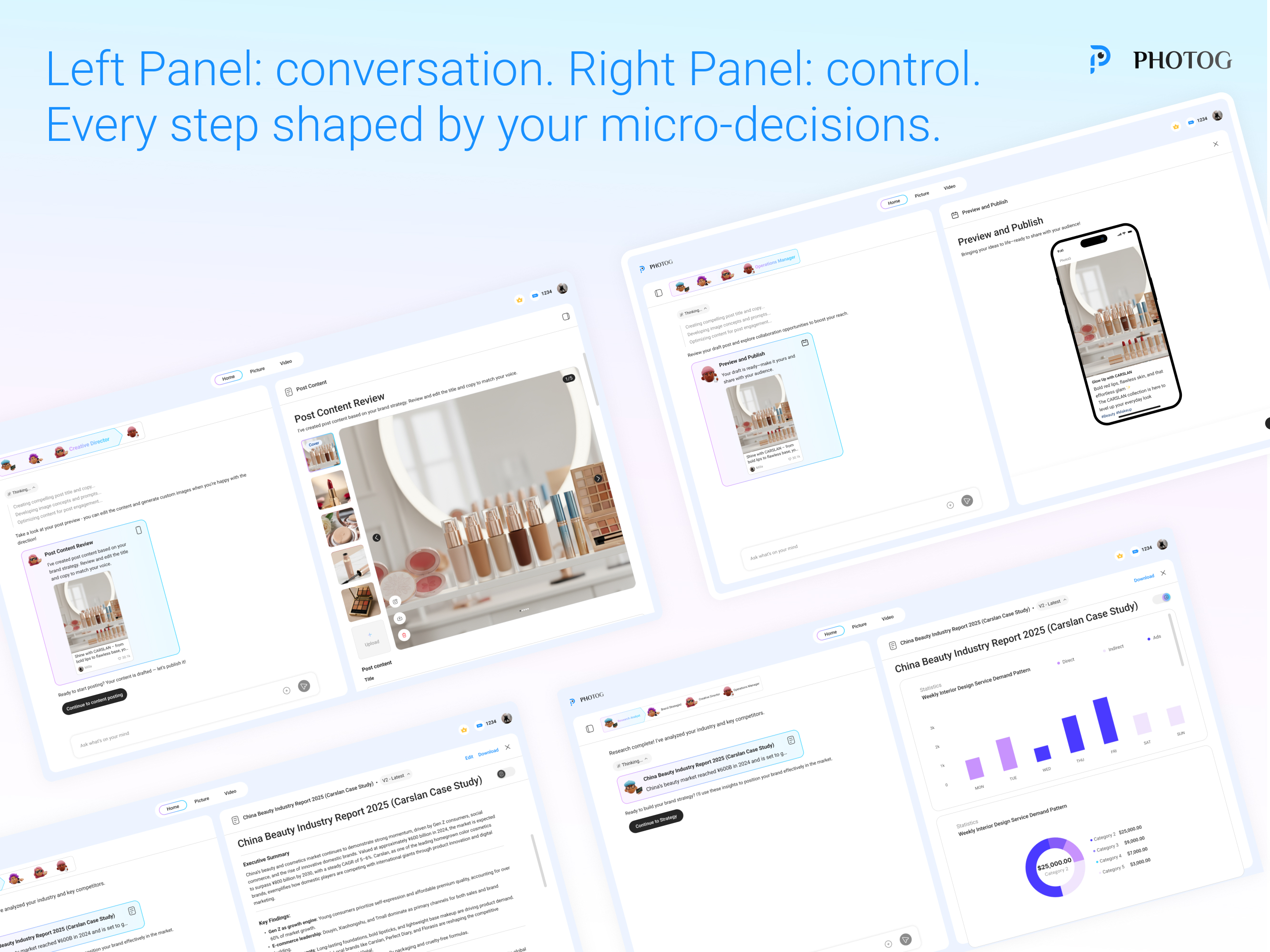
The screen is split in two. The left panel is where you talk to the team. You brief, ask follow-ups, and steer the work the way you would in any meeting. The right panel is where the work actually happens. Drafts, visuals, edits, all updating in real time as each agent does their part. Every step is shaped by your micro-decisions.
The funding window was tight. There was no PM. We worked end to end on research, architecture, UX, visuals, the design system, and engineering handoff, all at once. The rule we held to: every design decision had to be defensible in a 60 second demo.